Introduction
Every service business dreams of having more clients. Then it happens. Five active projects. Three proposals waiting for approval. Two invoices overdue. A client asking for revisions. Another requesting an urgent call.
Suddenly, your biggest challenge isn't finding work — it's keeping everything organized.
If you've ever ended your day wondering "What did I even accomplish today?", you're not alone.
The good news? Managing multiple projects isn't about working longer hours. It's about building better systems.
The Hidden Cost of Context Switching
One of the biggest productivity killers isn't meetings. It's context switching.
Imagine this: You start designing a landing page. A Slack notification pops up. Then an email arrives asking for an invoice. A client messages on WhatsApp. You open Notion to check deadlines. Then switch to Google Drive. Then Stripe. Then Figma.
By lunchtime, you've opened ten different tools — but barely made progress on the actual work.
Every time you switch contexts, your brain needs time to refocus. Multiply that across an entire week, and you lose hours of productive work.
Why Projects Become Difficult to Manage
Most agencies don't struggle because they have too much work. They struggle because their workflow is fragmented.
Common signs include:
- Missing client deadlines
- Forgetting follow-ups
- Searching through email threads
- Duplicate files
- Confusing project status
- Payment reminders slipping through the cracks
Build a Repeatable Workflow
Every successful project follows a predictable journey. Instead of treating every client differently, create a standard workflow.
- Lead
- Proposal
- Contract
- Project Kickoff
- Milestones
- Client Review
- Final Delivery
- Payment
When every project follows the same process, your team always knows what comes next. Consistency reduces mistakes.
Break Projects Into Milestones
Large projects feel overwhelming. Smaller milestones feel achievable.
Instead of one massive deadline, divide projects into phases like:
- Discovery
- Research
- Design
- Development
- Testing
- Launch
Each milestone should have a clear objective, a due date, an assigned owner, a client approval step, and a payment milestone.
This makes progress visible for both your team and your clients.
Stop Relying on Memory
If your project management system is your brain, it's already overloaded.
Write everything down. Track tasks, deadlines, client feedback, meeting notes, files, and deliverables.
Communicate Proactively
Clients don't like surprises. Neither do project managers.
Instead of waiting for clients to ask for updates, share progress regularly. Simple updates like:
- Milestone completed
- Waiting for approval
- Design phase finished
- Development started
Help build confidence without requiring lengthy meetings. Transparency reduces unnecessary follow-ups and keeps everyone aligned.
Centralize Everything
One of the biggest reasons projects become chaotic is information being scattered across different tools.
Imagine managing proposals in Google Docs, contracts as PDFs, tasks in Notion, files in Drive, payments in Stripe, conversations in Slack, and client approvals in email.
Every project becomes a treasure hunt.
Instead, keep everything connected in one workspace. The less time you spend searching for information, the more time you spend delivering value.
Prioritize Impact Over Urgency
Not every notification deserves immediate attention.
Start each day by identifying:
- One high-impact task
- Two medium-priority tasks
- Quick administrative work
Finish the important work before responding to every message. Being busy isn't the same as being productive.
How ORKA Helps You Manage Multiple Projects
ORKA is designed to give service businesses one place to manage their entire client lifecycle. Instead of juggling multiple platforms, you can:
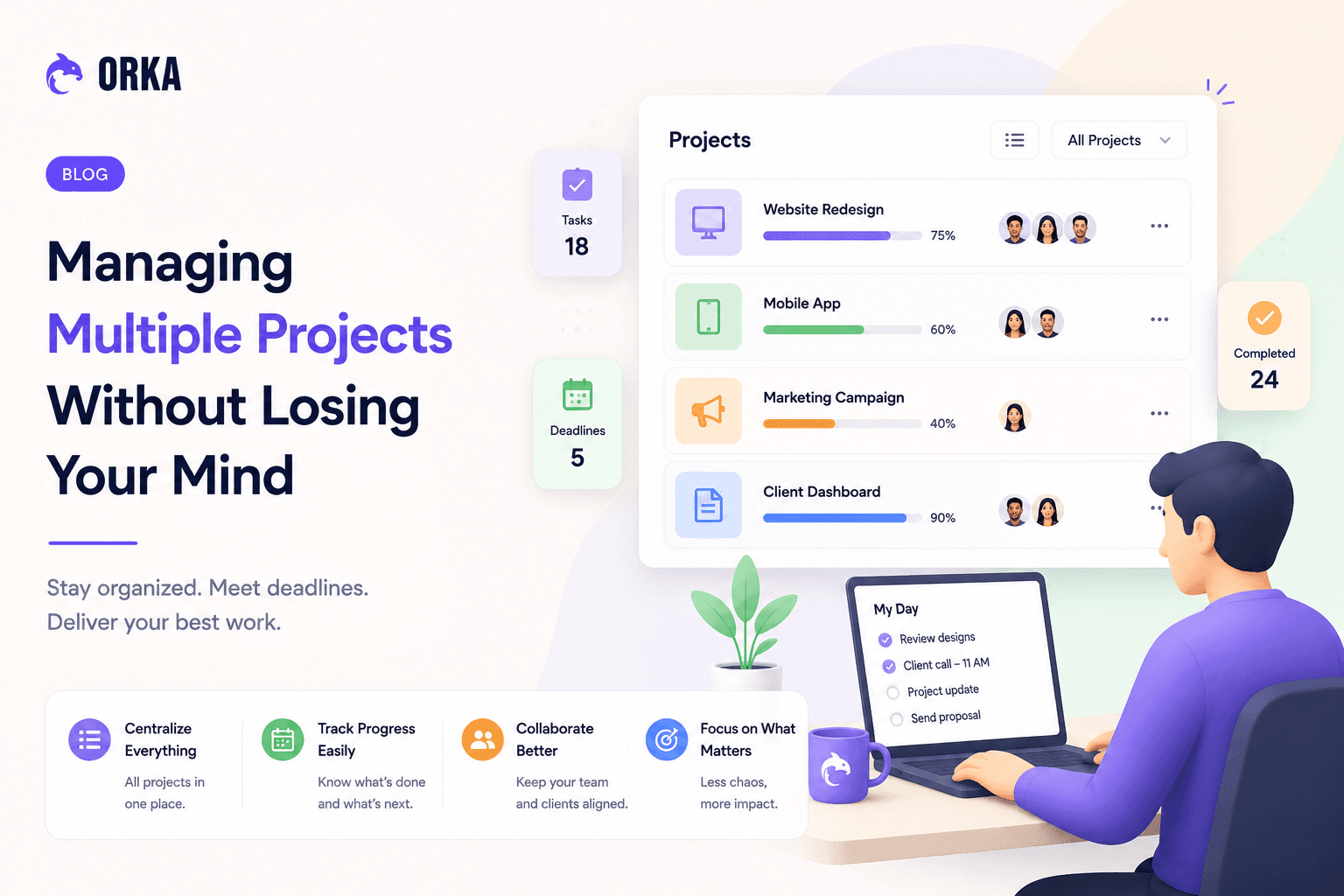
- Track every project from a single dashboard
- Organize proposals and contracts
- Manage milestones and timelines
- Monitor payments and invoices
- Store client information
- Generate AI-powered proposals
- Keep project communication organized
Everything stays connected, making it easier to focus on delivering great work instead of managing scattered information.
Final Thoughts
Growth shouldn't feel like chaos. The more clients you take on, the more important your systems become.
Managing multiple projects isn't about becoming better at multitasking. It's about creating processes that reduce complexity.
When every proposal, contract, milestone, payment, and client update lives in one organized workspace, your business becomes easier to manage — and much easier to scale.
Key Takeaways
- Context switching is one of the biggest productivity killers.
- Standardize your workflow across every client project.
- Break large projects into manageable milestones.
- Stop relying on memory — document everything.
- Keep communication proactive and transparent.
- Centralize projects, payments, contracts, and client information in one place.
- Strong systems allow your business to scale without overwhelming your team.
Ready to Organize Every Client Project?
ORKA helps freelancers, agencies, and modern service businesses manage projects, proposals, contracts, milestones, payments, and client communication — all from one unified workspace.
Build better systems, reduce chaos, and spend more time doing the work you love.